Next.js 13.5
Next.js 13.5 includes 22% faster local server startup, 29% faster HMR (Fast Refresh), 40% less memory usage, and more.
1 min readNews

Next.js 13.5 includes 22% faster local server startup, 29% faster HMR (Fast Refresh), 40% less memory usage, and more.
Following the graduation of Pod-Level Resources to Beta in v1.34 and the General Availability (GA) of In-Place Pod Vertical Scaling in v1.35, the Kubernetes community is thrilled to announce that In-Place Pod-Level Resources Vertical Scaling has graduated to Beta in v1.36! This feature is now enabled by default via the InPlacePodLevelResourcesVerticalScaling feature gate. It allows users to update the aggregate Pod resource budget (.spec.resources) for a running Pod, often without requiring a container restart.
Kubernetes v1.36 introduces Pod-Level Resource Managers as an alpha feature, bringing a more flexible and powerful resource management model to performance-sensitive workloads. This enhancement extends the kubelet's Topology, CPU, and Memory Managers to support pod-level resource specifications (.spec.resources), evolving them from a strictly per-container allocation model to a pod-centric one. Why do we need pod-level resource managers?When running performance-critical workloads such as machine learning (ML) training, high-frequency trading applications, or low-latency databases, you often need exclusive, NUMA-aligned resources for your primary application containers to ensure predictable performance.
Node.js® is a free, open-source, cross-platform JavaScript runtime environment that lets developers create servers, web apps, command line tools and scripts.
Node.js® is a free, open-source, cross-platform JavaScript runtime environment that lets developers create servers, web apps, command line tools and scripts.
Node.js® is a free, open-source, cross-platform JavaScript runtime environment that lets developers create servers, web apps, command line tools and scripts.
Learn about what security protections are built-in Next.js and view a guide for auditing applications.

Next.js 14 includes included performance, stability for Server Actions, a new course teaching the App Router, and more.
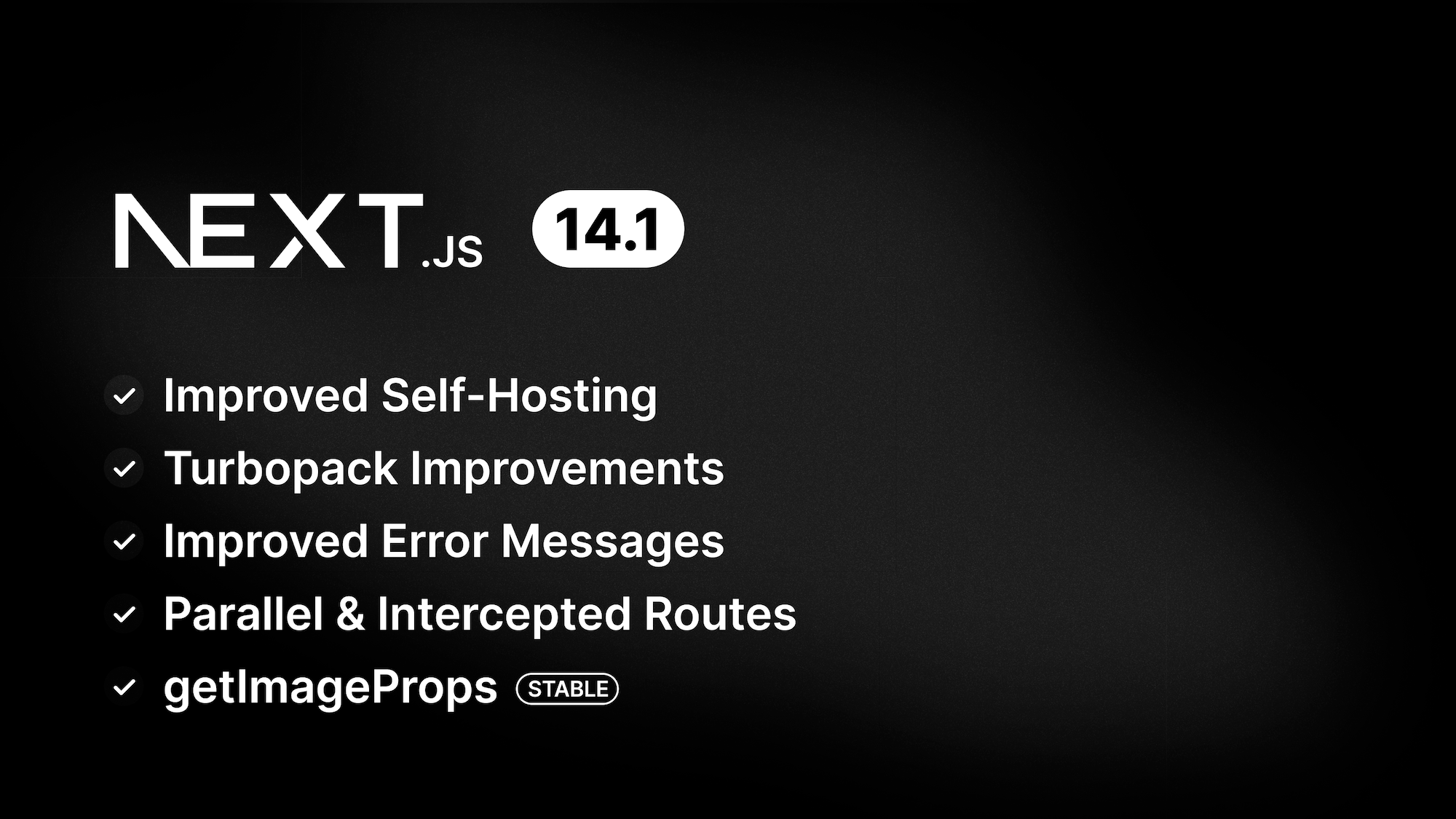
Next.js 14 includes improvements to self-hosting, error messages, parallel and intercepted routes, Turbopack, and more.
If you've ever tried to enforce a security policy across a fleet of Kubernetes clusters, you've probably run into a frustrating chicken-and-egg problem. Your admission policies are API objects, which means they don't exist until someone creates them, and they can be deleted by anyone with the right permissions. There's always a window during cluster bootstrap where your policies aren't active yet, and there's no way to prevent a privileged user from removing them.
In Kubernetes v1.36, Declarative Validation for Kubernetes native types has reached General Availability (GA). For users, this means more reliable, predictable, and better-documented APIs. By moving to a declarative model, the project also unlocks the future ability to publish validation rules via OpenAPI and integrate with ecosystem tools like Kubebuilder. For contributors and ecosystem developers, this replaces thousands of lines of handwritten validation code with a unified, maintainable framework. This post covers why this migration was necessary, how the declarative validation framework works, and what new capabilities come with this GA release.
As Kubernetes clusters grow to tens of thousands of nodes, controllers that watch high-cardinality resources like Pods face a scaling wall. Every replica of a horizontally scaled controller receives the full stream of events from the API server, paying the CPU, memory, and network cost to deserialize everything, only to discard the objects it is not responsible for. Scaling out the controller does not reduce per-replica cost; it multiplies it.