
Next.js 15
Next.js 15 introduces React 19 support, caching improvements, a stable release for Turbopack in development, new APIs, and more.
1 min readNews
Next.js 15 introduces React 19 support, caching improvements, a stable release for Turbopack in development, new APIs, and more.
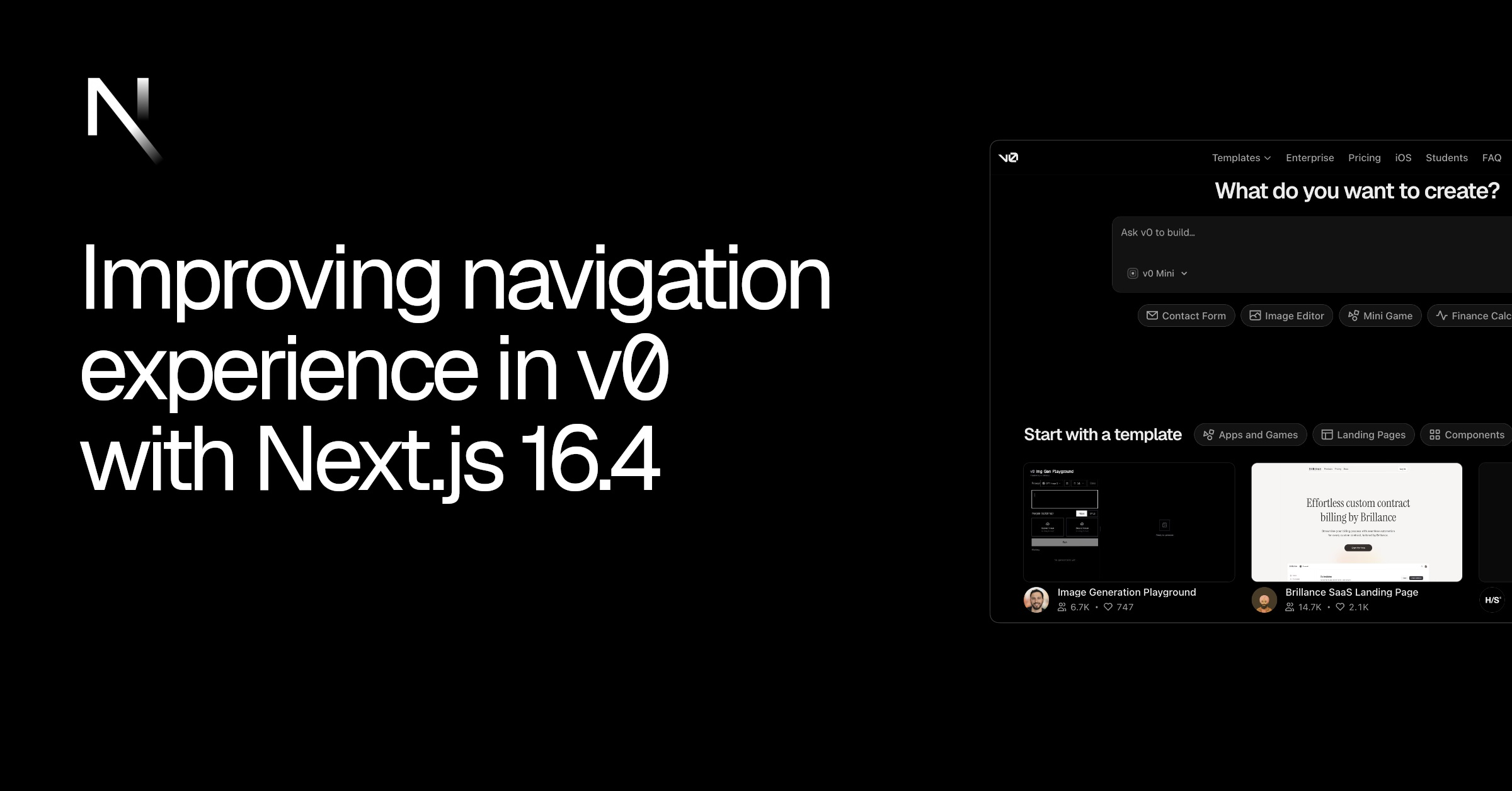
How we used Partial Prefetching and a coding agent to improve navigation across v0 with Next.js 16.4.
AI/ML and batch workloads introduce unique scheduling challenges that go beyond simple Pod-by-Pod scheduling. In Kubernetes v1.35, we introduced the first tranche of workload-aware scheduling improvements, featuring the foundational Workload API alongside basic gang scheduling support built on a Pod-based framework, and an opportunistic batching feature to efficiently process identical Pods. Kubernetes v1.36 introduces a significant architectural evolution by cleanly separating API concerns: the Workload API acts as a static template, while the new PodGroup API handles the runtime state. To support this, the kube-scheduler features a new PodGroup scheduling cycle that enables atomic workload processing and paves the way for future enhancements. This release also debuts the first iterations of topology-aware scheduling and workload-aware preemption to advance scheduling capabilities. Additionally, ResourceClaim support for workloads unlocks Dynamic Resource Allocation (DRA) for PodGroups. Finally, to demonstrate real-world readiness, v1.36 delivers the first phase of integration between the Job controller and the new API.
The .spec.externalIPs field for Service was an early attempt to provide cloud-load-balancer-like functionality for non-cloud clusters. Unfortunately, the API assumes that every user in the cluster is fully trusted, and in any situation where that is not the case, it enables various security exploits, as described in CVE-2020-8554. Since Kubernetes 1.21, the Kubernetes project has recommended that all users disable .spec.externalIPs. To make that easier, Kubernetes also added an admission controller (DenyServiceExternalIPs) that can be enabled to do this. At the time, SIG Network felt that blocking the functionality by default was too large a breaking change to consider.
Back in Kubernetes 1.28, we introduced the Mixed Version Proxy (MVP) as an Alpha feature (under the feature gate UnknownVersionInteroperabilityProxy) in a previous blog post. The goal was simple but critical: make cluster upgrades safer by ensuring that requests for resources not yet known to an older API server are correctly routed to a newer peer API server, instead of returning an incorrect 404 Not Found. We are excited to announce that the Mixed Version Proxy is moving to Beta in Kubernetes 1.36 and will be enabled by default! The feature has evolved significantly since its initial release, addressing key gaps and modernizing its architecture.
The 2026 Stack Overflow Developer Survey shows only 7% of developers trust AI output for important decisions. Here’s what that means for running agents safely.

Node.js® is a free, open-source, cross-platform JavaScript runtime environment that lets developers create servers, web apps, command line tools and scripts.
Node.js® is a free, open-source, cross-platform JavaScript runtime environment that lets developers create servers, web apps, command line tools and scripts.
Node.js® is a free, open-source, cross-platform JavaScript runtime environment that lets developers create servers, web apps, command line tools and scripts.
Learn about our journey with caching in Next.js App Router.

Next.js 15.1 introduces React 19 stable support, improved error debugging, new experimental authorization APIs, and more.
Learn more about the API design and benefits of 'use cache'
