
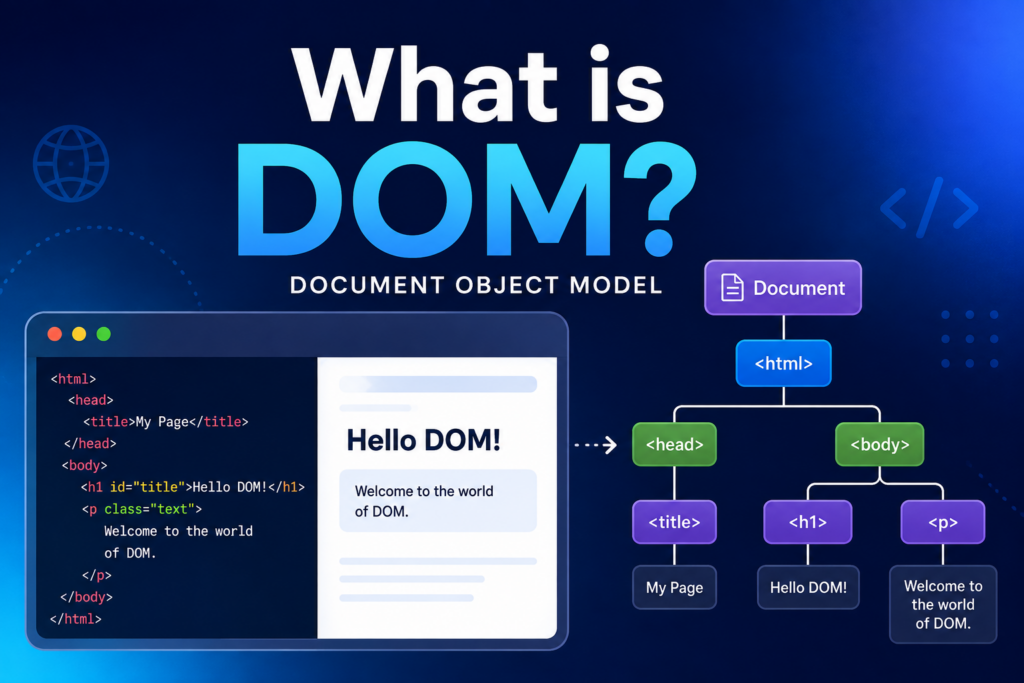
What is DOM?
DOM stands for Document Object Model. It is the structural representation of all nodes in an HTML document. DOM represents the structure of your applications. DOM manipulation is required to dynamically change the content of a web page. DOM is an interface that allows scripts to update the content, style, and structure of the document.
In this article, we will discuss the Document Object Model (DOM) along with its properties and methods used to manipulate documents and understand their implementation through examples. The Document Object Model (DOM) is a programming interface for HTML (HyperText Markup Language) and XML (Extensible Markup Language) documents. It defines the logical structure of documents and the way a document is accessed and manipulated.
Note: It is called a logical structure because DOM doesn’t specify any relationship between objects. DOM is a way to represent the webpage in a structured hierarchical way, making it easier for programmers and users to navigate through the document. With DOM, we can easily access and manipulate tags, IDs, classes, attributes, or elements of HTML using commands or methods provided by the Document object. Using DOM, JavaScript gains access to both the HTML and CSS of the web page and can also add behavior to the HTML elements. In essence, the Document Object Model is an API that represents and interacts with HTML or XML documents.
Continue Reading
You've reached the end of the free preview. Subscribe free to unlock the rest of this article.



Discussion (0)